The June 2026 release of NX for Manufacturing introduces new capabilities across CAM programming, AI-assisted manufacturing, machining operations, shopfloor support, and data management. The latest release is designed to help manufacturers improve productivity, simplify programming, and further connect engineering with manufacturing.
Siemens NX Release 2606
What's New in NX for Manufacturing 2606
 Natalja Glubrecht |
NX Manufacturing (CAM)
NX CAM 2606 introduces optimized process patterning, background toolpath generation, intelligent fixture automation, new chamfer mill tools, expanded planar deburring, enhanced face milling, and adaptive rough turning. These improvements reduce programming effort and cycle times while increasing process reliability and tool life.
Expansion of New Functions from NX 2512
Background Generate moves toolpath computation to a secondary NX process, allowing programmers to continue working in the main session without interruption. Status indicators show progress and queued operations in real time, while intelligent dependency management protects parent operations during generation. Fixture Automation uses intelligent positioning algorithms to automatically align fixtures with workpieces. Dynamic part repositioning provides immediate visual feedback, while simplified dialogs support faster fixture library management and setup creation. Together, these functions reduce idle waiting time, programming effort, and setup time, especially for complex parts with multiple operations and setups.
Front and back chamfer mill tool
NX now includes a dedicated tool type for front and back chamfer mill tools. The purpose-built interface provides clearly labeled fields for front angle, back angle, cutting diameter, and overall length. ISO-standard naming conventions are applied automatically, ensuring consistency across the tool library and simplifying communication with tool vendors and shop floor personnel.
Dedicated chamfering-specific geometry parameters improve tool definition accuracy, simulation results, collision checking, and material removal verification. This reduces the risk of geometry mismatches and errors reaching the shop floor. For companies that regularly perform chamfering operations, the new tool type saves definition time and creates consistent, reusable tool records across manufacturing sites.
Expanded Planar Deburring
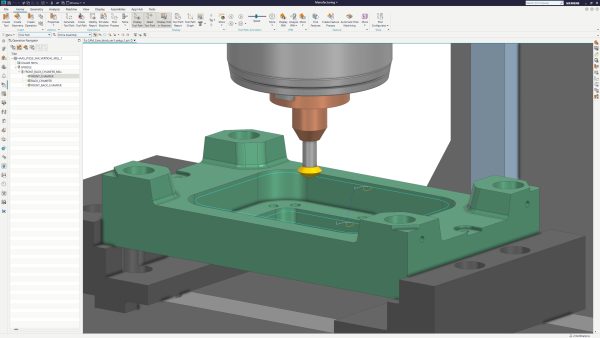
Planar Deburring now supports Front Chamfer Mills, Back Chamfer Mills, Dovetail Mills, and Spherical Mills, providing the appropriate tool geometry for different edge conditions. A single operation can deburr the top side, bottom side, or both sides of a planar part, eliminating separate operations for each side. New path settings include overlap distance for closed contours, height control for engage and retract motions, and a linear engage type for a smoother, more predictable approach. These enhancements improve edge quality, reduce programming time, and minimize the need for additional setups or workarounds.
Enhanced Face Mill Zig Zag
Face Mill Zig Zag now supports multiple face selection when the blank type is set to thickness. A single operation can machine several faces using either a user-defined or system-optimized cutting order to minimize non-cutting motion. New controls for motion across voids and adjustable cut angles provide greater control over tool engagement and surface finish on parts with holes, pockets, or interrupted surfaces. These enhancements reduce the number of operations, manual sequencing, and non-cutting machine motion, resulting in shorter programming and cycle times.
Native adaptive roughing with Rough Turn Adaptive
Rough Turn Adaptive brings native adaptive roughing to NX CAM for hard-to-machine materials such as Hastelloy and Inconel. The strategy maintains consistent chip thickness throughout the cut, supporting uniform wear of ceramic inserts and reducing localized loads. Smooth engage and retract motions minimize impact shocks, while corner cleanup passes ensure consistent material removal. This enables higher material removal rates, controlled cutting forces, and longer tool life. Native integration with simulation, post-processing, and machine setup also eliminates the need for separate third-party adaptive turning solutions.
Further new features
NX X Manufacturing
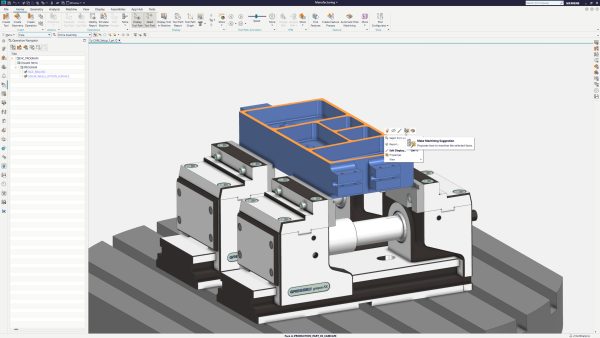
The latest release introduces new CAM only packages, full Teamcenter X integration for managed .nxmv data, IPW visualization for viewing the machining status after each operation, and complete turning support in the Manufacturing Viewer. In addition, the AI Make Machining Suggestion function now provides history free Generative AI recommendations and can automatically create parametric tools when required. These enhancements improve data consistency, process transparency, setup reliability, and programming efficiency.
NX On-machine probing
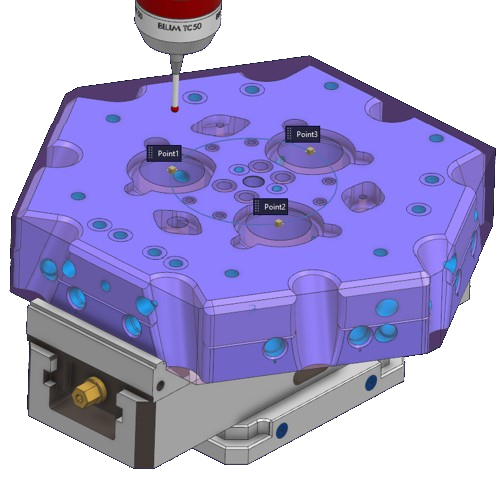
NX On-machine probing integrates measurement, alignment, tool control, and adaptive correction directly into the CAM workflow. New capabilities include standardized tool-setting cycles, intelligent probing logic, and automated Cut-Measure-Cut processes. This reduces reliance on shop floor macros, increases first-time-right quality, and supports closed-loop machining.
Built-in Support for Third-Party Tool-Setting Cycles
Integrated tool-setting cycles from Blum-Novotest and Renishaw support both non-contact laser measurement and contact probing. The functions cover initial tool length and diameter measurement, wear compensation, and tool breakage detection across a wide range of CNC controls. Cycle output is generated through the standard postprocessor infrastructure and is available through Post Hub, eliminating the need to maintain separate machine-specific macro libraries.
Enhanced Probing with TCL Logic
TCL logic snippets can now be embedded in NX CAM Notes and processed as Post Configurator commands during NC code generation. This enables calculations, conditions, and variable assignments based on measurement results without manually editing the NC program. Relative operation references make probing templates reusable across different parts and setups.
Closed-Loop CAM Automation
Probing, alignment, tool measurement, and adaptive machining are combined in one CAM workflow. Cut-Measure-Cut sequences can machine a feature, measure the result, automatically apply tool corrections, and remachine the feature without operator intervention. Standardized postprocessor layers provide consistent, traceable, and machine-specific NC output, creating a solid foundation for autonomous and self-correcting manufacturing.
You can find more information about the new functions on the Siemens Blog: What’s new in NX for manufacturing.
 Natalja Glubrecht
Marketing Expert
E-Mail: Natalja.Glubrecht@janus-engineering.com
Author of the article / Autorin des Beitrags
Topics:
Articles on similar topics


Subscribe to our blog
Tips and news around digital manufacturing.