In the modern manufacturing industry, tool management plays a crucial role in ensuring an efficient manufacturing workflow and optimal tool utilization. What are the benefits of these systems and what can be gained by merging the real and virtual worlds together? This blog provides an overview of the topic of tool management, how it serves as a link, and the advantages and disadvantages it entails.
Physical and Virtual Tool Management
An overview and comparison
 Andy Krummenacher |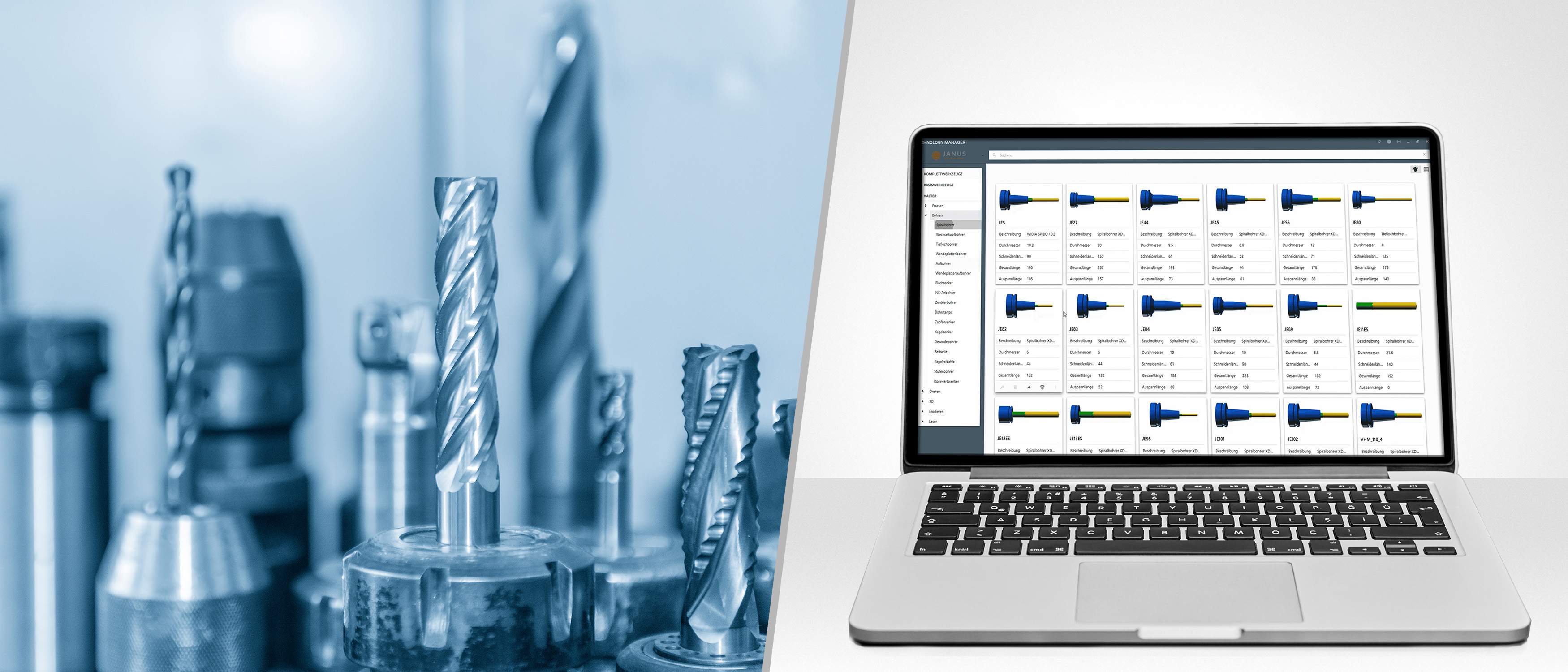
Physical and Virtual Tool Management
As it is already the norm in CAD/CAM and many other areas, digital twins are also used in tool management. A distinction is often made between physical and virtual tool management. The following example shows a possible mode of operation in both systems and illustrates the common points.
The physical tool management still partially follows a traditional concept in which tools are organized and managed in real-existing storage systems such as paternoster or tool magazine. The tooling assemblies that are currently in use on the machine tools are not the only items being stored, all individual components required for the construction are also maintained. During the tool setup, components are taken from the inventory and reordered as needed. The search and reordering of the tools is done manually by the employee. After assembly, the complete tools are measured for their exact dimensions; many companies use a tool presetting device. The determined tool geometry data is typically printed on labels or lists and attached to the tool. During the machine loading process, these data are manually input into the control system by the employee.
Virtual tool management uses digital solutions and technologies to optimize the tool management process, minimize errors and depict the manufacturing process as realistically as possible. As mentioned at the beginning, when using the tools in CAM software for achieving a highly accurate simulation, a precise digital twin for each tool is required. Each of these tools is enriched with master data during creation and stored in a database, e.g., Siemens Teamcenter with Manufacturing Resource Library (MRL) or Janus Technology Manager (TMGR). Since the data is stored and managed centrally, this results in comprehensive data availability. By categorizing all tools and resources, the CAM programmer is facilitated in their search for the correct tool through relevant attributes. This not only saves time and money but also simplifies the management of components and tools.
Advantages and Disadvantages
Tools have a significant cost factor in manufacturing and play a relevant role in the need for data and information throughout the virtual as well as physical process chain. Below are the key advantages and disadvantages of both systems:
Advantages of physical tool management:
- The concept is familiar and does not require extensive training.
- Employees can physically oversee the inventory of tools, directly control them, and easily identify maintenance needs.
- Lower initial investments are required when implementing physical tool management. Expensive technology is typically not needed.
Disadvantages of physical tool management:
- Time-consuming search for the desired tool without digital support.
- Manual effort for monitoring and reordering tools is time-consuming.
- Complete inventory is not visible, the absence of a clear overview of tools currently in use on the machine tools.
- The susceptibility to errors in manual processes increases the risk of human errors and inconsistencies.
Advantages of virtual tool management:
- Comprehensive data availability through centralized data management.
- Time savings by efficiently locating suitable resources via attributes.
- Easy management of tools and components.
- Cost and inventory reduction through improved visibility.
- Efficient creation of complete tool sets.
Disadvantages of virtual tool management:
- The implementation of virtual tool management initially requires a significant investment in technology and employee training.
- Components and complete tools can only be managed virtually and do not impact the physical management of tools.
- Inventory Visibility by default is not available, but it is possible to display it through an interface with an existing inventory system.
Tool Management Software
From a critical size of the tool inventory, conventional tool management reaches its limits. With the use of an own tool management software, master data from virtual tool management can be inherited and used. At the same time, this eliminates the need for manual inventory overview, and reordering can be automated. Long searches for the desired tool become unnecessary. With a simple click, you can get a list of materials for each tool to be set up, including its storage location. By managing the tool assemblies, the system recognizes which tools are still missing for the next order and automatically generates a loading and unloading list. With the right interface to the ERP or MES system, you can obtain all the necessary information for setting up the tools for the next orders. Orders with the same tools can be combined or the number of setup operations minimized. By means of suitable interfaces, the measurement data can be directly transmitted to the control system or a Distributed Numerical Control (DNC) system. Alternatively, it can be stored in the physical tool through a scannable code or memory chip with a unique identifier.
In machining manufacturing, tool management software can be very valuable in systematically organizing information about existing tools and seamlessly integrating it into the production process. It is not uncommon for tooling costs to take up a significant factor in manufacturing costs. This makes it even more important to look into suitable systems and make their advantages work for oneself.
Reasons for using Tool Management Software
Cost optimization: Tools often represent a significant cost factor in manufacturing. Efficient management can help companies reduce excess inventories, make targeted procurements, and optimize costs.
Resource efficiency: A good tool management software ensures optimal use of available resources, such as real-time monitoring of tool lifetimes. Tools are used purposefully to minimize downtime and better utilize production capacity.
Quality improvement: The correct choice and use of tools makes a significant contribution to the quality of the parts produced. Systematic management supports achieving the desired quality and reducing scrap.
Time savings: Well-organized tool management software reduces search times, as required tools can be quickly found and provided.
Advantages and Disadvantages of Tool Management
Advantages of Tool Management:
- Digitalization: Tool management software serves as a bridge between physical and virtual tool management, creating a seamless connection between machines, presetting devices, storage systems, and ERP, PLM, and MES systems.
- Cost Efficiency: Optimized demand planning and tool utilization can lower tool costs.
- Standardization: Standardizing tool data helps curb proliferation and reduces tool variety.
- Higher Productivity: Digitalization enables an efficient production workflow and minimal waiting times at machines.
- Reduced Setup Times: Pre-set tools with stored tool offset data minimize setup times on machines.
- Real-time Data: Information on tool lifetimes and usage is immediately available, enabling informed decisions.
- Automation: The process of tool identification, monitoring, and reordering can be automated.
- Process Security: Using correct and precise tools ensures higher process security and quality control.
Disadvantages of Tool Management:
- Initial Effort: The introducing of a new tool management software requires time and resources.
- Technological dependence: Faulty virtual solutions can disrupt the workflow. Dependable technology is crucial for the smooth operation of the system.
Tool management software is essential for companies of any size and orientation in the manufacturing industry and forms the basis of future-oriented manufacturing. Whether it is small workshops or large production facilities, efficient tool management software contributes to increased productivity and competitiveness.
 Andy Krummenacher
CAx Consultant
E-Mail: Andy.Krummenacher@janus-engineering.com
CAx Consultant
Topics:
Subscribe to our blog
Tips and news around digital manufacturing.